
Chapter 1
What science means
This chapter covers the public’s understanding of the term “science”, their connection to science in their everyday lives, and the UK’s perceived standing when it comes to science. This helps to provide a wider context for the rest of the findings from the study. For the first time, several questions were asked not just about science but also about “research and innovation”, to understand if this term invoked different feelings.
Chapter 1
What science means
This chapter covers the public’s understanding of the term “science”, their connection to science in their everyday lives, and the UK’s perceived standing when it comes to science. This helps to provide a wider context for the rest of the findings from the study. For the first time, several questions were asked not just about science but also about “research and innovation”, to understand if this term evoked different feelings.
The overall story
People continue to see science as a big part of public life. Moreover, compared to 2019, more people have been talking about science with friends and family and fewer people felt that science is “not for them”. In addition, despite new advances in science and technology, the proportion saying these things are too complicated for the average person to understand has remained stable, at just under half.
However, other trends suggest a more mixed picture. Fewer felt informed about science than in 2019. A smaller majority than before agreed that the government should fund blue skies scientific research that brought no immediate benefits. And while there was a strong sense that investment in science and technology contributed to the country’s international competitiveness, there was also considerable uncertainty around whether the UK is a world leader in science.
These nuances may reflect that science means different things to different people. And people’s definitions often relate to how they interact with science in their daily lives. Furthermore, the terms “science” and “research and innovation” had slightly different connotations, which provides context for the rest of this report. Both terms were commonly associated with words like progress and improvement. However, science more commonly brought to mind specific fields or subjects, whereas research and innovation was more often linked to themes like technology (including artificial intelligence), creativity and ideas.
Headlines
1.1 Associations with science, and with research and innovation

We asked people, without prompting, about the words that came to mind when thinking about the term “science”. The most common categories of responses were:
33%
Specific scientific fields and subjects
30%
Research and Investigation
29%
Innovation, Progress and Improvement
21%
Medicine, Health and Disease prevention
And for the first time, we asked the same question but in relation to “research and innovation”. This generated the answers such as:
42%
Innovation, Progress and Improvement
25%
Technology and Tools, which included AI (specifically mentioned by 6%)
20%
The future, and Visionary thinking
This highlights the perceived strong overlaps between science, and research and innovation – in both cases, mentions of innovation, progress and improvement were common. However, it also shows that the two terms had slightly different connotations among the public. Technology, tools and AI were more strongly associated with research and innovation than science (25% versus 14%). Science was more commonly associated with specific fields or subjects than research and innovation (33% versus 15%).
Beyond these top-most connotations, there were other areas of overlap and difference among lesser chosen words or phrases. For example, for both terms, similar proportions of people mentioned positive values, ethics and benefits (14% for science, and 17% for research and innovation). However, the concepts of creativity and ideas generation were more commonly associated with research and innovation than with science (14% versus 3%).
Demographic differences
Demographic differences highlight that science means different things to different people, as does research and innovation.
There were differences by gender. When thinking about “science”, women were more likely than men to talk about research and investigation, and to raise medicine, health, and disease prevention. When considering “research and innovation”, men were more likely than women to mention technology, tools and AI.
Both terms also had different connotations among younger and older generations, potentially reflecting their own interactions with science. For science, young people aged 16 to 24 were more likely than average to mention specific scientific fields and subjects. For research and innovation, they were more likely to highlight technology, tools and AI. By contrast, older people aged 65 or over were more likely to raise medicine, health and disease prevention when they heard research and innovation. Older people were also more likely to mention the positive values, ethics or benefits that they associated with both terms. This reflects some of the age differences seen across the rest of this report, with young people being less inherently positive towards science.
When thinking about “science”, women were more likely than men to talk about research and investigation, and to raise medicine, health, and disease prevention.

1.2 Connectedness to science, and research and innovation

Feeling and keeping informed
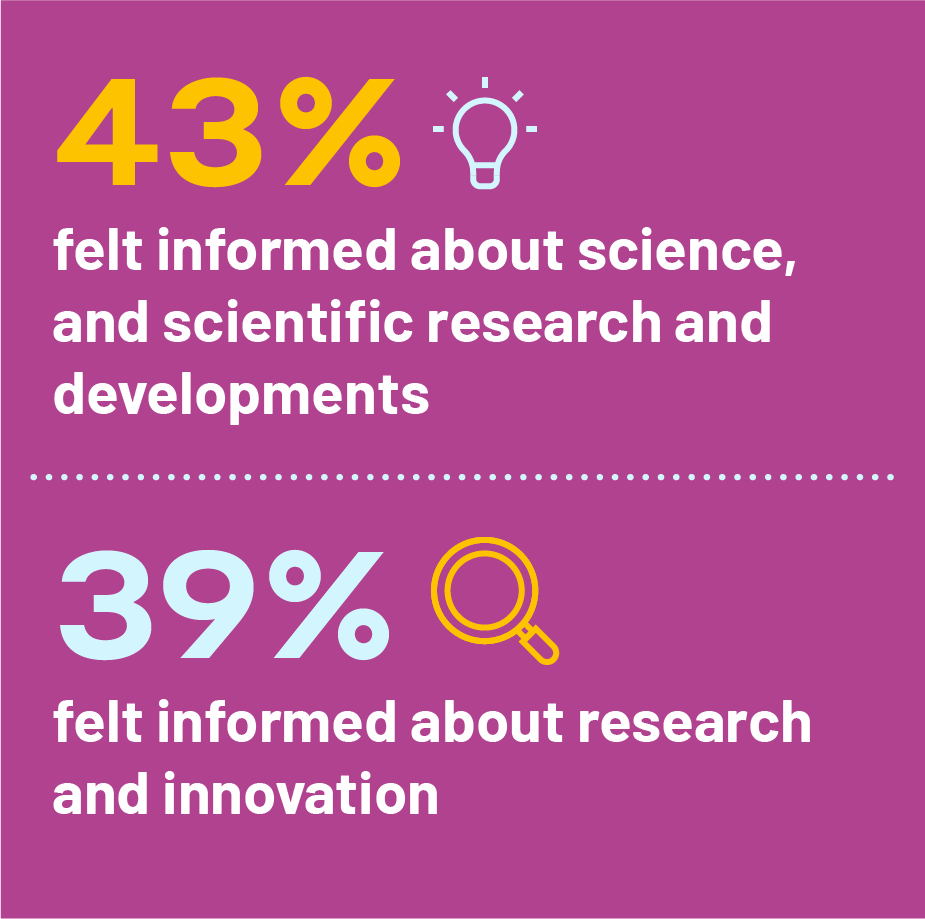
PAS has regularly asked the public how informed they feel about “science, and scientific research and developments”. The proportion feeling well informed about science has fallen (from 51% in 2019 to 43% in 2025). The latest result is more in line with previous years, although it had notably been trending upwards until now – it was 40% in 2005, 43%in 2011 and 45% in 2014.
This year for the first time, we also asked a similar question to see how informed people felt about research and innovation. As the chart below shows, these questions had very similar responses, with more of the public saying they felt uninformed than informed.
A separate question sheds more light on these findings. We asked the public to summarise their relationship with science against a series of options. A fifth (21%) said they felt connected with science, i.e., they actively sought out science news, events, activities or entertainment – this group might be described as highly engaged. The most common answer was that they were interested in science but did not make a special effort to keep informed (63%). A further 16% said that science was not for them, i.e. they were largely disengaged.
The people who felt uninformed about science were not necessarily keen to find out more. Among the fifth who felt connected with science and actively sought out content, just 14% said they felt uninformed.
Nevertheless, there has been a reduction in those who feel disengaged from science. In 2025, fewer people said that science was not for them (16%, versus 22% in 2019). More said they were interested but did not make a special effort to keep informed (63%, versus 56% in 2019).
Since 2000, the survey has asked people whether they agree or disagree that the more they know about science, the more worried they are. In 2025, 22% agreed, 37% neither agreed nor disagreed, and 40% disagreed. The chart below shows that agreement has trended downwards over time. People have instead shifted towards neither agreeing nor disagreeing.
Finally in this section, we also cover people’s conversations about science, which offers further evidence that outright disengagement has fallen. One in three people (31%) reported speaking about science with friends and family at least once a week, as the chart below indicates. One-fifth (22%) said they rarely or never spoke about science. This latter proportion has also dropped since 2019, when this question was first asked (from 32%, to 22% in 2025).
Men were more likely than women to feel informed about science (51% versus 35%).
Several demographic differences were apparent across these questions. These are consistent with previous years, and there was a similar pattern when asking about research and innovation rather than science:

Men were more likely than women to feel informed about science (51% versus 35%).

Younger people also tended to feel more informed about science than older people (53% of 16 to 24 year-olds felt well informed, versus 36% of those aged 65 or over).

Graduates were also more likely than average to feel informed about both science (54%, versus 43% overall), and research and innovation (48%, versus 39% overall). However, there were stark differences between those with science and engineering degrees (76% well informed), and those with social science degrees (51%) or arts and humanities degrees (47%).
Later in Chapter 3, we look at how informed people felt about specific areas of science or specific technologies.
Science and technology in people’s lives
Several questions highlight an ongoing common interest in science across the UK public, stretching back to at least 2000 (when many of these questions were first asked). However, more recent shifts suggest this interest in science is less strong than before. While outright disengagement has fallen (as covered in the previous section), this has not led to deeper engagement and interest.
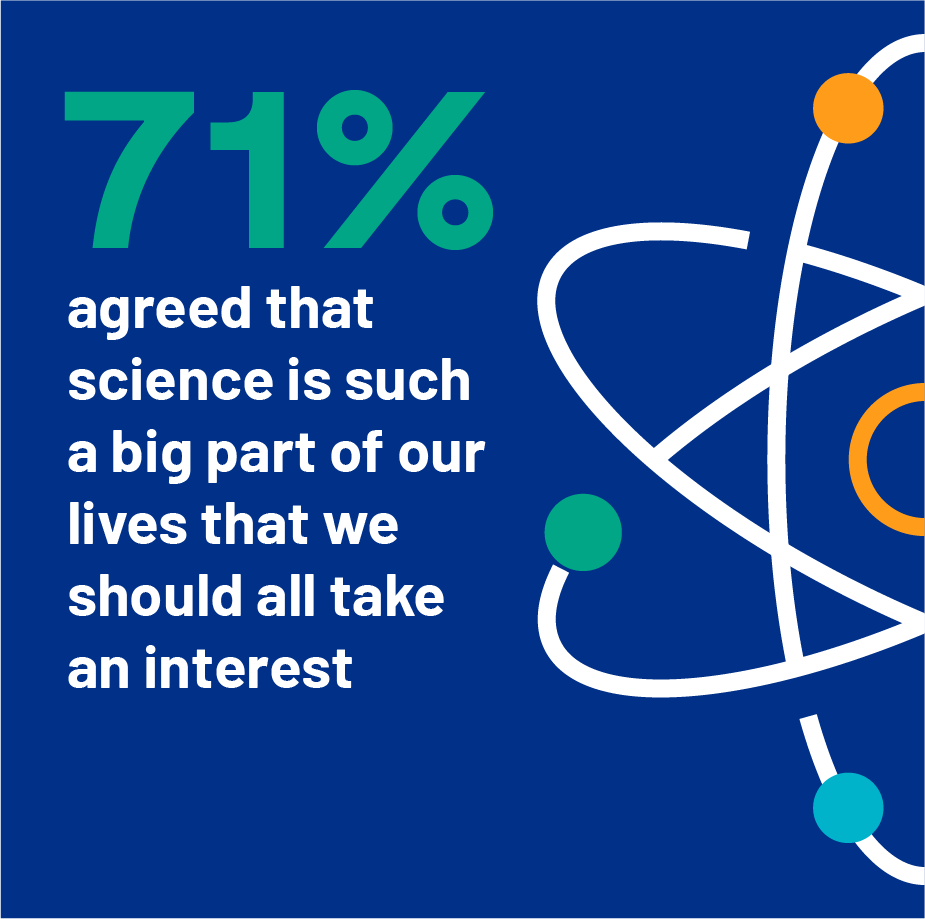
Seven in ten (71%) agreed that science is such a big part of our lives that we should all take an interest. It is worth noting that this has fallen since 2019 (from 82% to 71%), having been relatively stable since the 2008 survey. Separately, around two-thirds (64%) agreed it is important to know about science in my daily life. While this latter result was similar in 2019, it had already fallen from a high of 72% in 2014.
People have become more accustomed to scientific development and technological change.
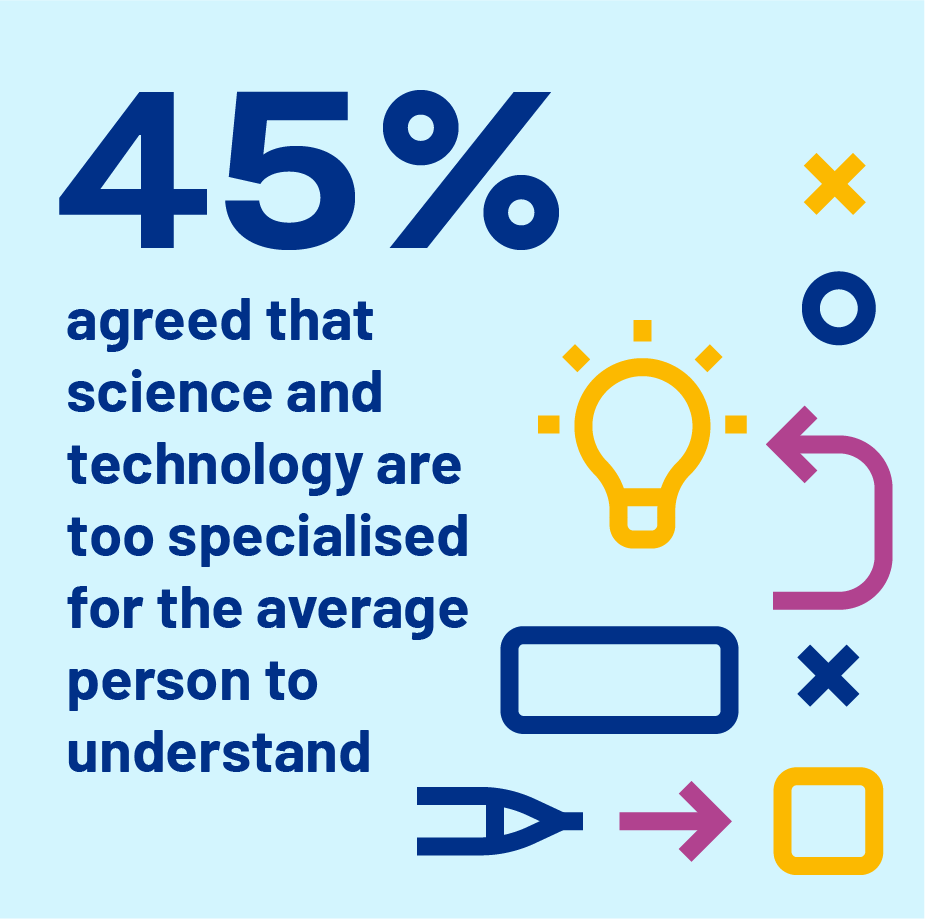
The long-term trend shows that people have become more accustomed to scientific development and technological change. In 2000, 66% thought that science and technology were too specialised for most people to understand them. In 2025, this has fallen to 45% (see below). The more recent trend, from 2019 to 2025, shows no change. This is notable given the significant technological advances since 2019, particularly the widespread integration of AI tools in public life. However, there were important demographic differences (by age and science capital), covered at the end of this section.
Finally in this section, we cover perceptions of science alongside faith, and science alongside personal experience.
%
or 6 in 10 disagreed that we depend too much on science and not enough on faith. This attitude has shifted greatly since this was first asked in 1988, as the chart below shows. The 1996 and 1988 data are taken from earlier social attitudes surveys carried out in the UK, before the PAS series came into being.
%
disagreed that we depend too much on science and not enough on personal experience – a new question for 2025. A quarter (24%) agreed with this opinion, and 36% neither agreed nor disagreed.
These questions highlighted important differences by age, ethnicity and science capital:

Younger people aged 16 to 24 were less likely than average to agree that science is such a big part of our lives, we should all take an interest. On the other hand, older people aged 65 or over were more likely than average to feel that science and technology were too specialised for most people to understand.

People with low science capital – i.e., those who had fewer interactions with science or scientists in their own daily lives – were also less likely than average to think that science is such a big part of our lives, we should all take an interest, and more likely than average to say that science and technology were too specialised for most people to understand.

There was more scepticism about the value of science versus faith, and versus personal experience, among ethnic minorities, particularly those from Black and Asian ethnic backgrounds (shown below).
1.3 The benefits of science and the UK’s position in science

This section helps provide a wider context for the rest of the report, in terms of understanding how the public valued science, and what they thought of the UK as a global contributor to science, and to research and innovation. Two questions encapsulate the complexities in opinions about the value of science.
Negative sentiment about the potential harms of science has receded. Half (53%) agreed that “the benefits of science outweigh any harmful effects”. A further third (33%) neither agreed nor disagreed, and 13% disagreed, i.e., they thought that science was more harmful than beneficial. The proportion disagreeing was the lowest it has ever been, tracing back to 26% in 1996 and 32% in 1988 (taken from earlier social attitudes surveys that were comparable to the later PAS series). Chapter 3 covers perceptions about the benefits and risks of specific areas of science and technology, and its perceived impact on society and the economy, delving deeper into this broad statement.
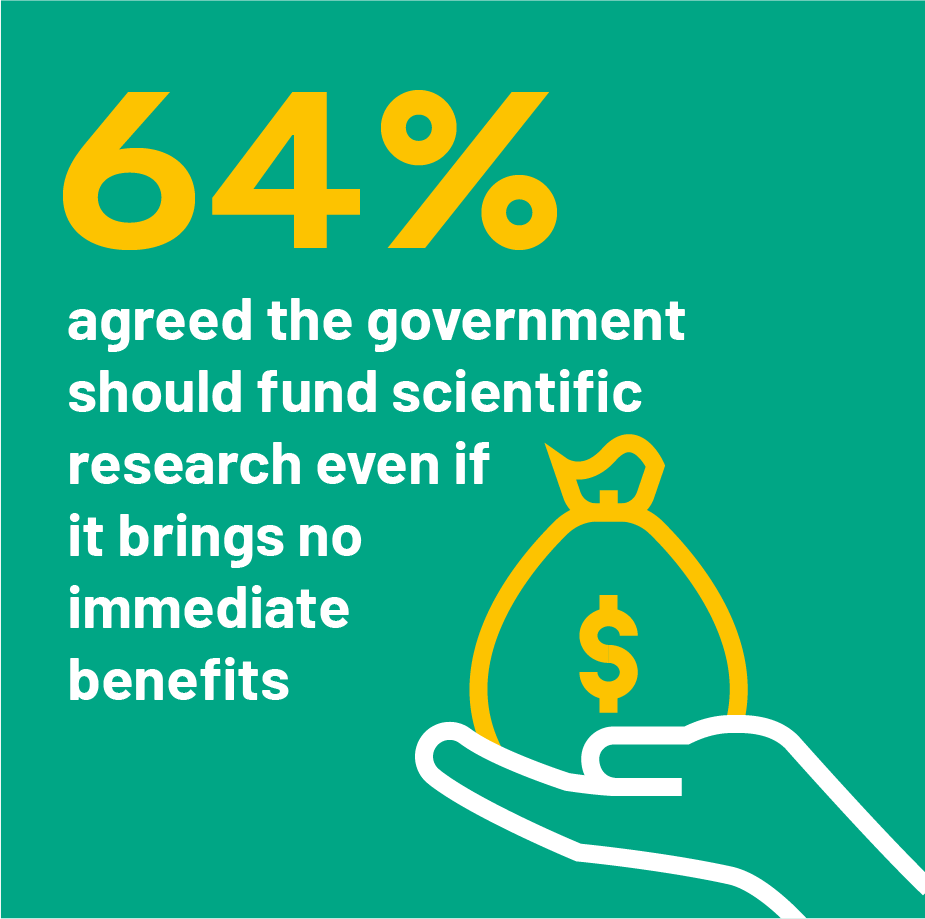
There was also majority support for blue skies scientific research, although this support has weakened since 2019. Two-thirds (64%) agreed that, even if it brings no immediate benefits, science which advances knowledge should be funded by the government – just 9% disagreed. However, this was down from previous waves (76% in 2011, 79% in 2014 and 79% in 2019).
There was majority support for government-funded blue skies scientific research, although this support has weakened since 2019.
Once again, these questions highlighted significant differences by gender, age, education and science capital:

Women were more likely than men to be uncertain or neutral about the benefits versus harms – 38% neither agreed nor disagreed that the benefits of science outweigh any potential harmful effects, versus 27% of men. This aligns with the earlier data showing that women tended to feel less informed and engaged with science.

Graduates were more likely than average to agree that the benefits of science outweighed the harms (64%, versus 52% overall) and that the government should fund blue skies research (73%, versus 64% overall).

Those with high science capital (who engaged more with science in their daily lives) were more likely to support government-funded blue skies research than those with low science capital (84% versus 43%).
Young people aged 16 to 24 tended to be less positive and more neutral about government-funded blue skies research (33% neither agreeing nor disagreeing, versus 25% overall).
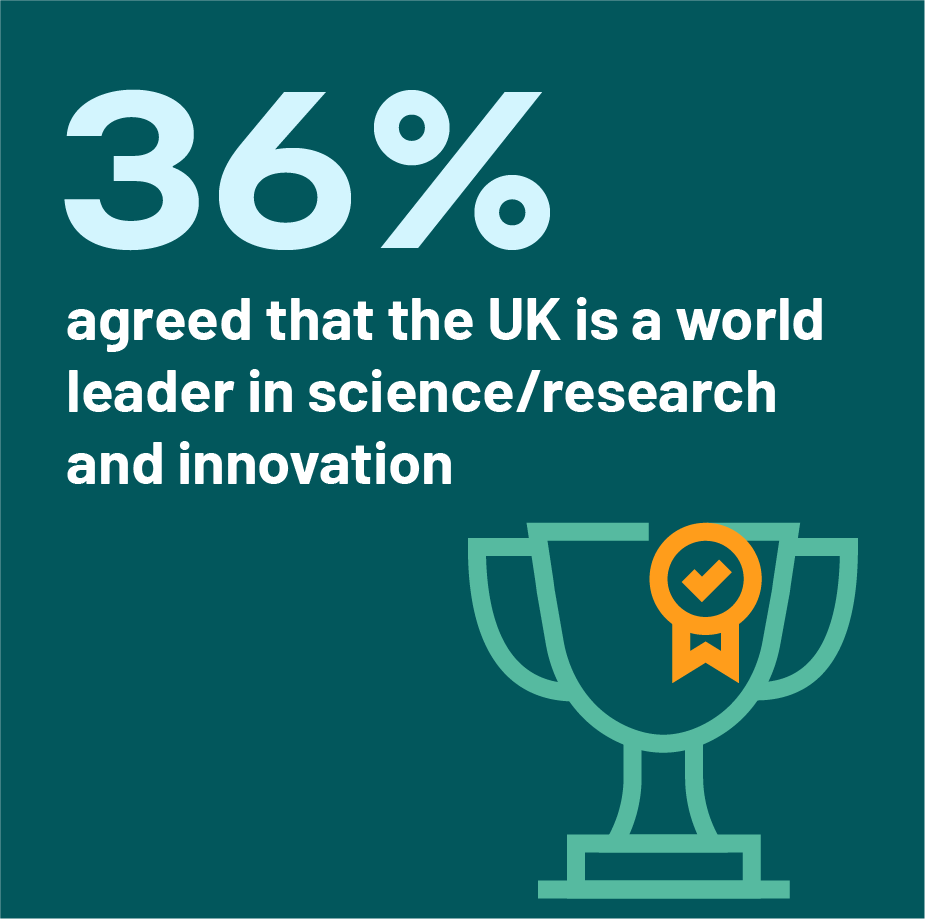
In new questions for 2025, we asked the public whether the UK was a world leader in science, and in research and innovation. This highlighted considerable uncertainty around the UK’s place globally in these areas. A minority of the public agreed in each case, with 36% considering the UK as a world leader in science, and 38% considering it a world leader in research and innovation. Graduates were more likely than average to see the UK as a world leader in science – and this was consistent among science and engineering graduates, and among arts and humanities graduates.
Despite the uncertainty about the UK’s current position, there was widespread agreement that the UK needed to develop its science and technology sectors to enhance its international competitiveness (75% agreed). This opinion has been strongly consistent since the question was first asked in 2000 (when 79% agreed). This year we also asked a parallel statement about the UK’s research and innovation sectors, and this had a very similar response, with 74% agreeing.
Later in Chapter 3, we report other data showing the perceived economic impact of science, and of research and innovation. This illustrates that clear majorities believed that science (64%) and research and innovation (69%) were drivers of economic growth in the UK.
%
agreed that the UK needed to develop its science and technology sectors to enhance its international competitiveness
