
Chapter 2
This chapter looks at public perceptions of those who work in science, including the traits associated with them, and the level of trust placed in them. Historically, these questions have been asked about scientists. We also asked certain questions for the first time about “researchers”, and about “people working in innovation roles”, to see if this framing evoked different attitudes.
Chapter 2
This chapter looks at public perceptions of those who work in science, including the traits associated with them, and the level of trust placed in them. Historically, these questions have been asked about scientists. We also asked certain questions for the first time about “researchers”, and about “people working in innovation roles”, to see if this framing evoked different attitudes.
The overall story
Scientists, researchers and people working in innovation roles were all viewed favourably in terms of their contributions to society. Scientists specifically were thought to represent a number of positive traits, including being interesting, creative, competent, well-intentioned, open-minded and responsible.
There was also a large amount of trust placed in scientists to follow the rules and regulations of their profession, although this continued to differ depending on the institutions they work for. Scientists working for the government, pharmaceutical companies and other private companies tended to be less trusted, as in previous years.
However, alongside this overall positive snapshot, the changes since 2019 suggest that people have become more uncertain or ambivalent about scientists’ contributions. That is, relatively large proportions providing neutral, rather than outright negative or positive responses. This pattern of results could be because people are in two minds, indifferent, lacking interest, or do not feel they know enough to judge – or for a mix of these reasons.
And while being ethical was commonly highlighted as the most important trait for scientist to embody, over two-fifths considered scientists to be neither ethical nor unethical, potentially impacting their sense of trust. Specifically, trust has declined in scientists working for the government and private companies.
Headlines
2.1 Scientists’ contributions to people’s lives

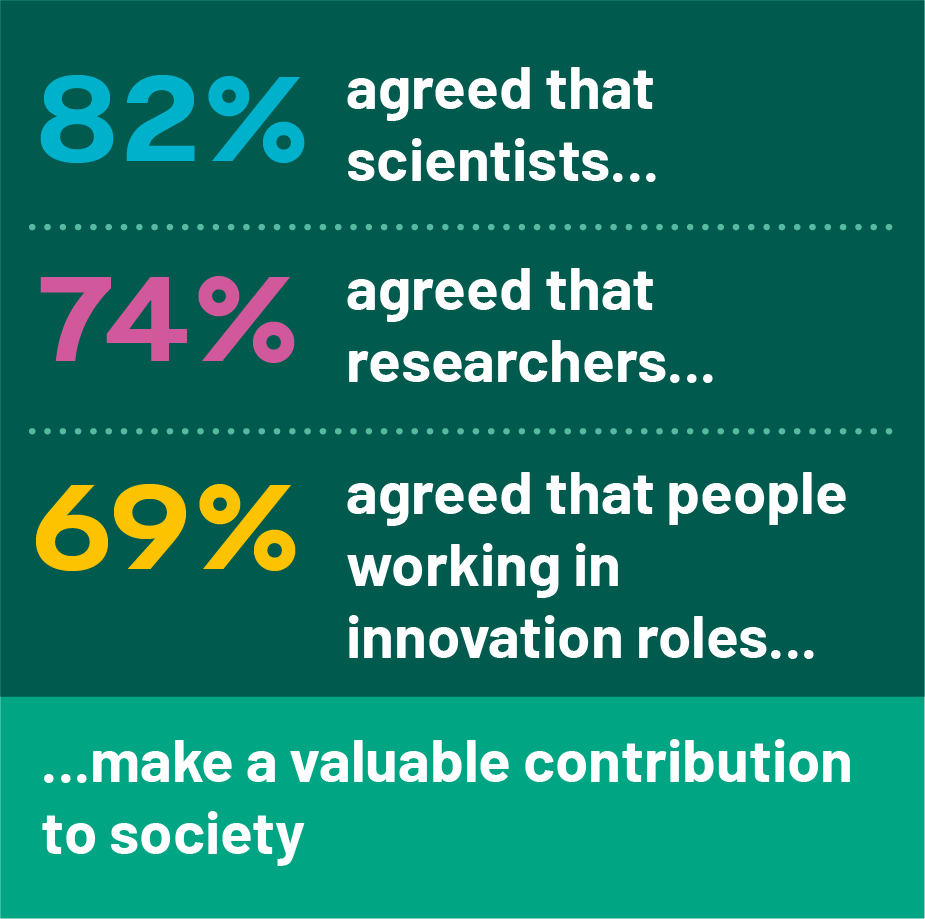
PAS has consistently highlighted positive attitudes among the public towards scientists. In this latest edition, 82% agreed that scientists make a valuable contribution to society, and 70% agreed that scientists want to make life better for the average person.
However, both these proportions have fallen since 2019, having been stable across previous years, as the chart below shows.
This does not indicate a rise in negative attitudes, but more an increase in uncertainty or ambivalence, i.e., more people neither agreeing nor disagreeing.
This pattern is frequently observed across the survey results, and more work may be needed to better understand what is behind it. It could be that people are in two minds, indifferent, lacking interest, or do not feel they know enough to judge – or a mix of these reasons.
For the first time in 2025, the question about scientists’ contribution to society was repeated to ask about “researchers” and “people working in innovation roles”. Here, there was less agreement – 74% agreed researchers make a valuable contribution to society and 69% felt this about people in innovation roles – but there was still a majority positive view of people in these roles.
It is important to point out that these groups – “scientists”, “researchers” and “people in innovation roles” – were not defined in the wording. Early questions in the survey showed that all three groups were understood in a largely similar way by those taking part. Moreover, the entire survey was primarily about science, which might have lessened the focus on researchers from other fields, such as the arts or humanities.
Other questions in the survey provide further context to these answers. For example, people were more likely to say they “don’t really know” what a researcher does (16% agreed they don’t know) than what a scientist does (11% agreed they don’t know). There was also a great deal of uncertainty or ambivalence as to whether scientists know best what is good for us – a new question for 2025. A fifth (21%) agreed with this statement, while a quarter (26%) disagreed, and half (51%) neither agreed nor disagreed.
Uncertainty or ambivalence as to whether scientists know best what is good for us was evident.

The findings suggest complex differences in attitudes to scientists by age group, as well as reflecting the gender differences mentioned elsewhere in the report:

Young people aged 16 to 24 were less inclined than average to agree that scientists make a valuable contribution to society and were less likely than older people to think scientists want to make life better for the average person. However, 16 to 24 year-olds were also the most likely age group to agree that scientists know best what is good for us.

Women were more likely than men to agree they did not know what a scientist does.

We asked people to rank from a list of words or phrases the top one to three traits they felt it was most important for scientists to have. In another question, we asked people whether scientists represent these traits or not. Similar questions were asked in the 2019 and 2014 surveys, but with a different list of answer options, so these cannot be directly compared.
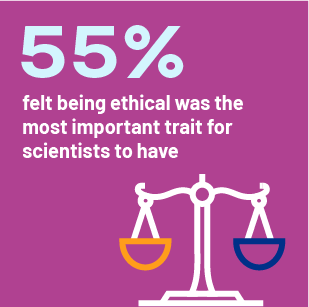
As the chart below illustrates, ethical behaviour (55%), competence (41%) and honesty (36%) came across strongly among people’s top three priorities.
It is worth noting that behaving responsibly (which is similar to the ethical and responsible traits below), and being open and transparent (which is similar to honesty below), have been found in other Ipsos research to be important drivers of trust in brands or in governments. This suggests certain traits are not only important for scientists but are broader drivers of trust. By contrast, competency appears to be a trait more uniquely important for trust in scientists.
Women were more likely than men to put ethical behaviour, having the right intentions and being representative of the UK population as one of their top three priorities. By contrast, men were more likely than women to list open-mindedness among their top three priorities.
As the chart below shows, a majority of the public associated scientists with positive traits, such as being interesting (66%), creative (66%), competent (65%), well-intentioned (63%), open-minded (57%) and responsible (56%).
A majority of the public associated scientists with positive traits.

The chart above also indicates many instances where people picked neither the positive nor the negative response, suggesting uncertainty in these areas. Notably, there was a high level of uncertainty as to whether scientists were ethical – 43% felt they were, but 44% said they were neither ethical nor unethical, or that it depended on the situation. This uncertainty was also high for keeping promises, shared values, communication and honesty.
The perception of scientists faking or adjusting results had become less prevalent.
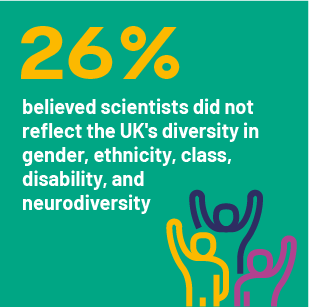
Again, further investigation may be needed into what is behind this uncertainty. More outright negative opinions came through in the proportions saying scientists were unrepresentative (26%), secretive (26%) and poor at communicating (22%).
For wider context, the survey includes a further measure of ethical behaviour. This suggests that the perception of scientists faking or adjusting results had become less prevalent. In 2025, 24% agreed that scientists adjust their findings to get the answers they want, while 33% disagreed. Young people aged 16 to 24 were more likely to agree (31%, versus 24% overall). Over time, across the public, this sentiment has been declining (down from 36% agreeing in 2011, 35% in 2014, and 31% in 2019, to 24% in 2025).
This section focuses on trust in scientists to follow rules and regulations, as well as parallel questions for researchers and engineers. We cover further data on trust in science information in Chapter 5.
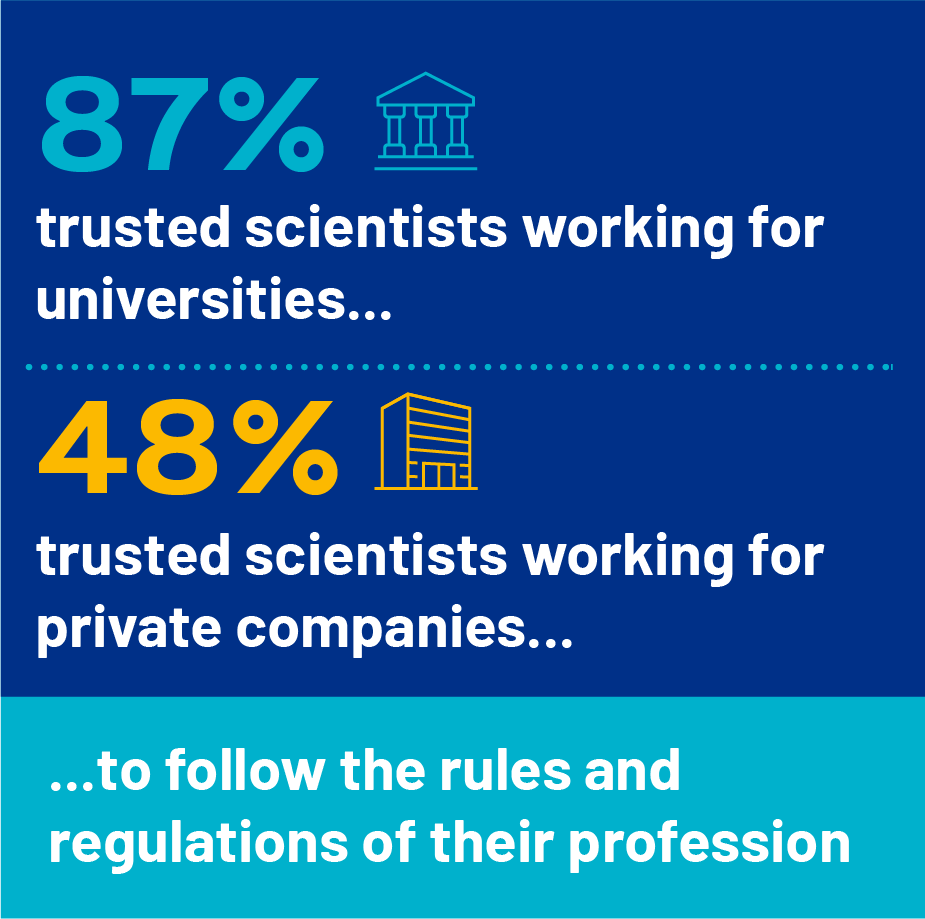
Previous editions of PAS have shown that trust in scientists, researchers and engineers is framed by the institutions they work for. This continues to be the case. People had considerable trust that scientists follow rules and regulations that apply to them, when they work in universities (87% trusted them a great deal or fair amount), for charitable organisations (84%) or for environmental groups (77%).
The majority also trusted scientists working for the government (69%) in this regard. Trust was much lower in scientists working for both pharmaceutical companies (60%) and other private companies (48%). There were similar differences by institution when these questions were asked of researchers or engineers.
Trust in scientists, researchers and engineers is framed by the institutions they work for.
Answers at these questions were broadly consistent with the 2019 survey, with two notable exceptions. There was a drop in trust in:

Scientists working for the government (down from 76% in 2019 to 69% in 2025)

Scientists working for private companies (down from 57% in 2019 to 48% in 2025).
These results cast a stark light on the COVID-19 pandemic’s impact on trust. The Wellcome Global Monitor from 2020 suggests that, internationally, trust in scientists rose during the pandemic. By contrast, Ipsos’ yearly Veracity Index has recorded a slight decline in trust in scientists in the UK post-pandemic, followed by a more recent recovery, but no long-term shift.
And other Ipsos polling for UKRI undertaken during the pandemic flags how difficult it is to produce a long-term shift in trust. In the UK, PAS 2025 suggests that pandemic‑era gains in trust in scientists were short‑lived rather than deep‑rooted. Moreover, they have been offset by growing concerns about scientists who work for government or private companies since the pandemic.
What would damage trust
People were asked what would be most likely to damage their trust in scientists. At this question, they were again asked to rank, from a list of words or phrases, the top one to three causes.
The answers here mirrored the question reported earlier in this chapter, on the traits people felt it was most important for scientists to represent. Unethical or irresponsible conduct was the most frequently selected behaviour that people said would damage their trust. The next most commonly chosen, but to a lesser extent, were incompetence, having the wrong intentions and a lack of transparency, as the following chart shows.
Unethical or irresponsible conduct was the most frequently selected behaviour that people said would damage their trust
Demographic differences
Once more, gender, age and science capital played a part in predicting who people trusted and why they trusted them:

Women demonstrated higher trust than men in scientists from charitable organisations and environmental organisations. On the other hand, men were more likely than women to trust scientists working for private companies.
Women were more inclined than men to identify unethical or irresponsible conduct a something that would damage their trust in scientists.
A higher percentage of 16 to 24 year-olds than average selected scientists having the wrong intentions as one of their top three reasons that their trust would be damaged.

Individuals with high science capital (defined as those who had more interactions with science in their daily lives) tended to exhibit higher trust in scientists, researchers and engineers regardless of where they worked.